Current Research Interests
This page contains some brief descriptions of my current research interests. For my published papers related to this topics, see the Research page.
Political Redistricting

Political redistricting can be abstracted as a graph partitioning problem subject to a variety of legal constraints. My main research in this area focuses on developing methods for efficient sampling of graph partitions usiing Markov chain techniques. I am also interested in shape based analysis of districting plans and metrics defined on the space of permissible graph partitions. For more details, see my overview of related resources here.
There are many interesting, open problems in this domain that are well suited for student research projects. I also maintain an active list of open mathematical problems related to redistricting here, please feel free to email me for more details if any of these catch your interest. Random Dot Product Graphs
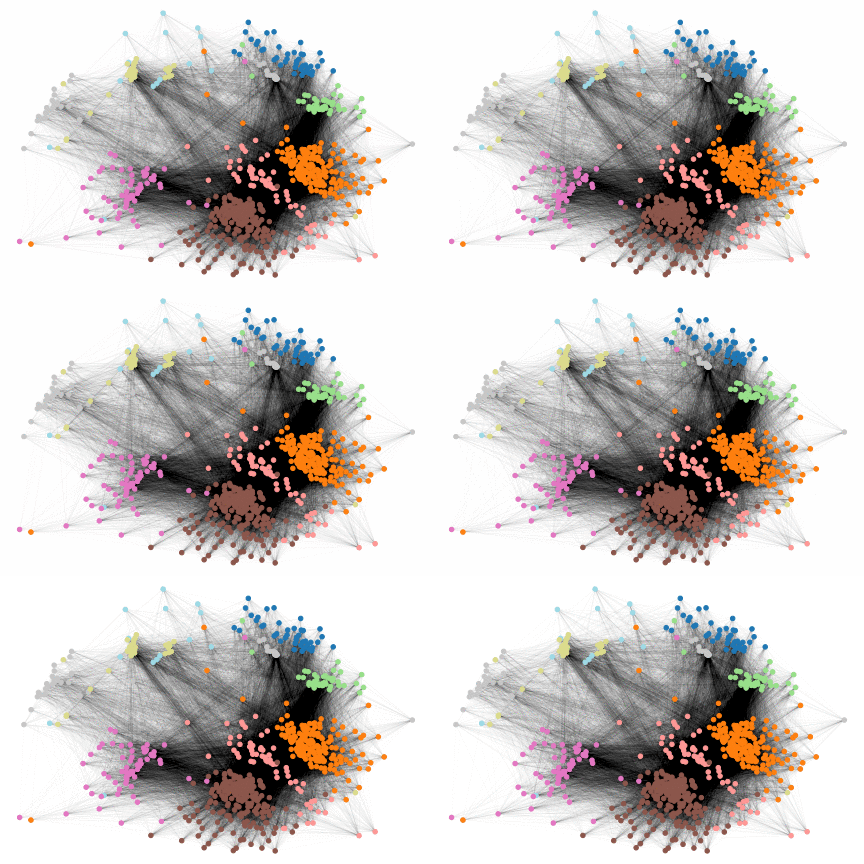
The Random Dot Product Graph (RDPG) model is a latent space model for complex networks, where each node is associated to a vector in \(\mathbb{R}^d\) and nodes are connected with probability equal to the dot product of their respective vectors. The geometry of this relationship provides natural connections to notions of comunity assignment and centrality as well as allowing for the construction of multiresolution models with community structure. This model has proven useful theoretically, for proving consistency results about spectral embeddings, as well as practically, with recent applications to many machine learning problems on graphs. I am particularly interested in methods for learning RDPG representations from empirical networks as well as proving results relating the geometric properties of the embeddings to the combinatorial structure of the associated graphs.
Entropy in Time Series
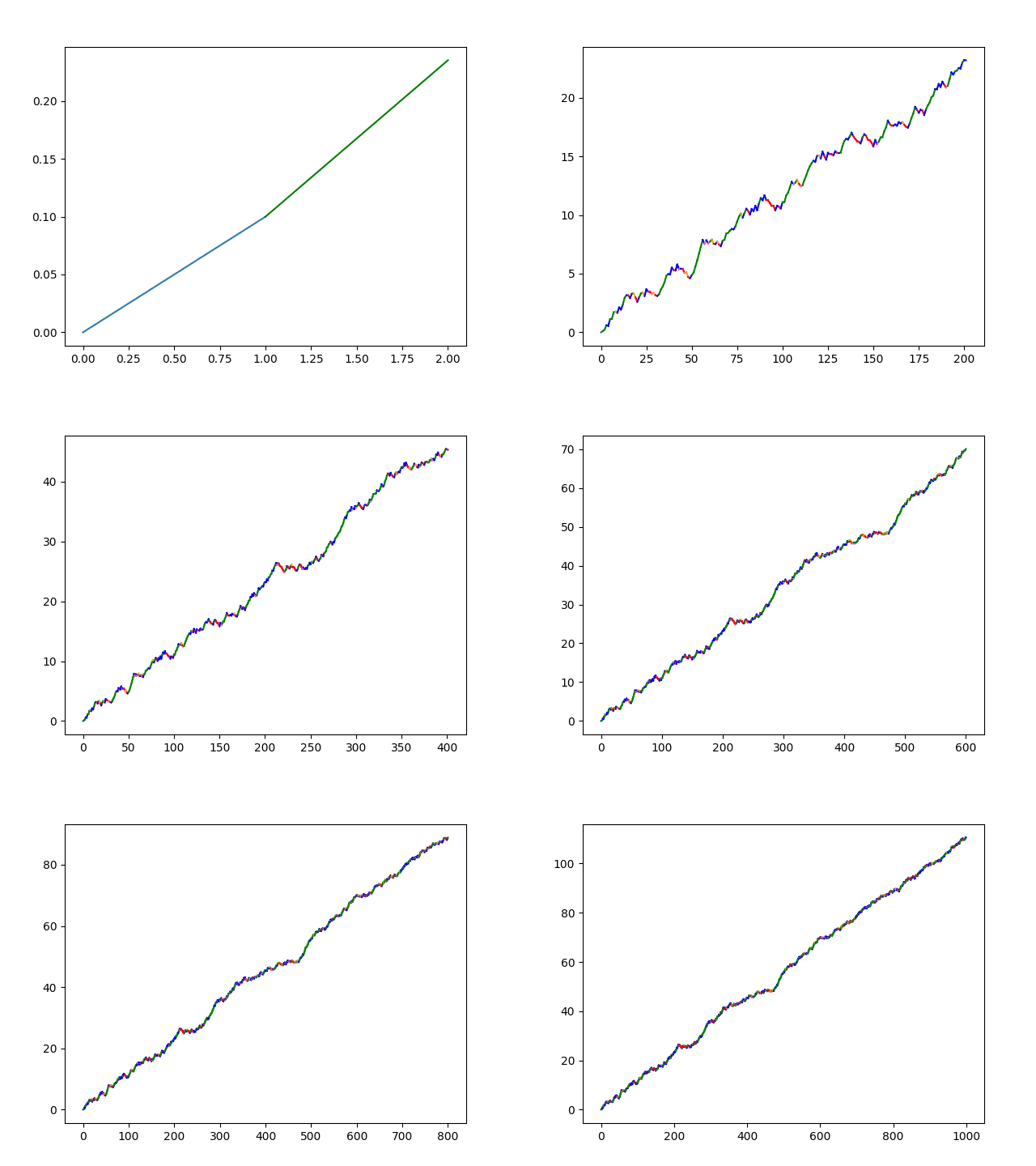
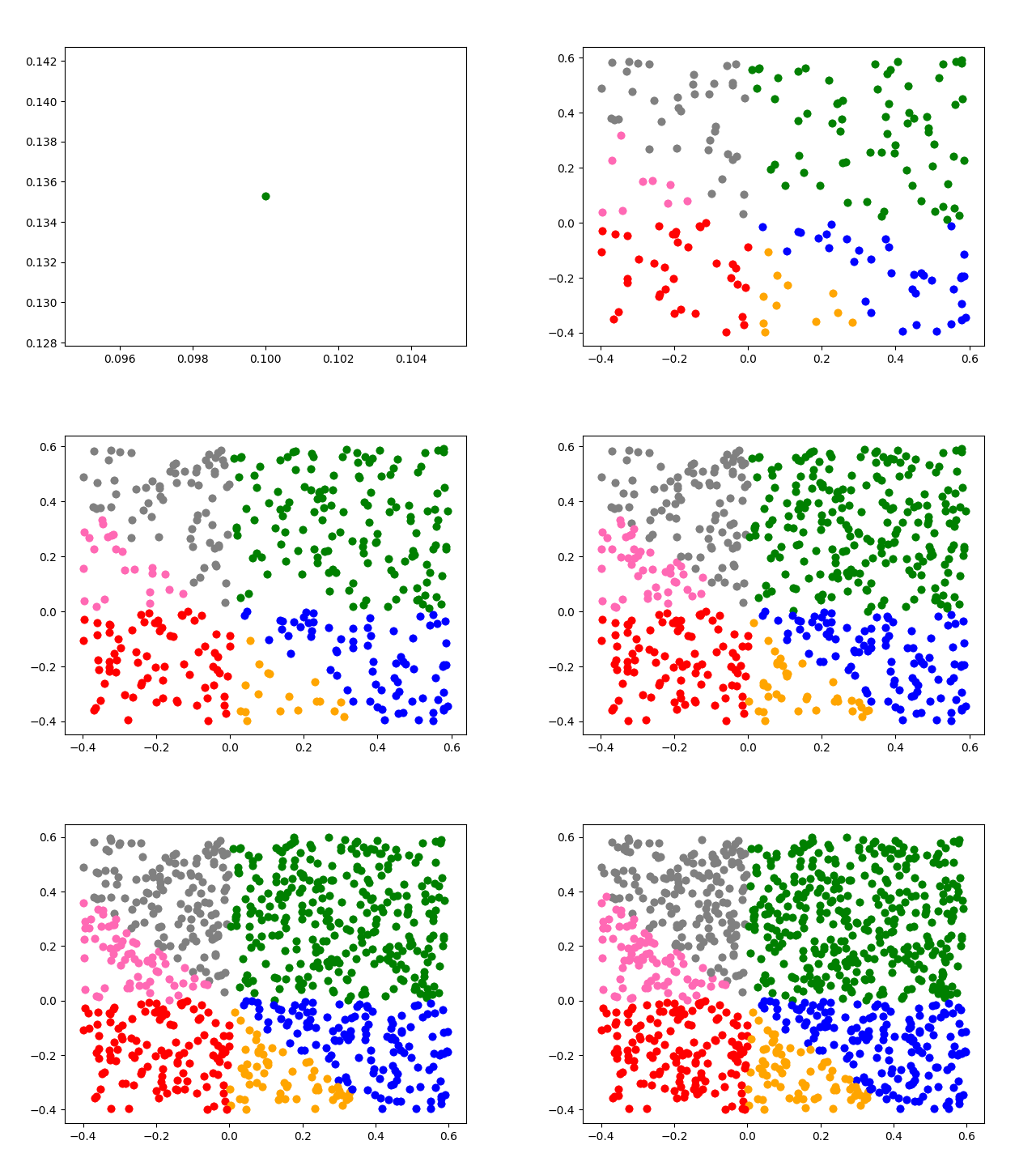
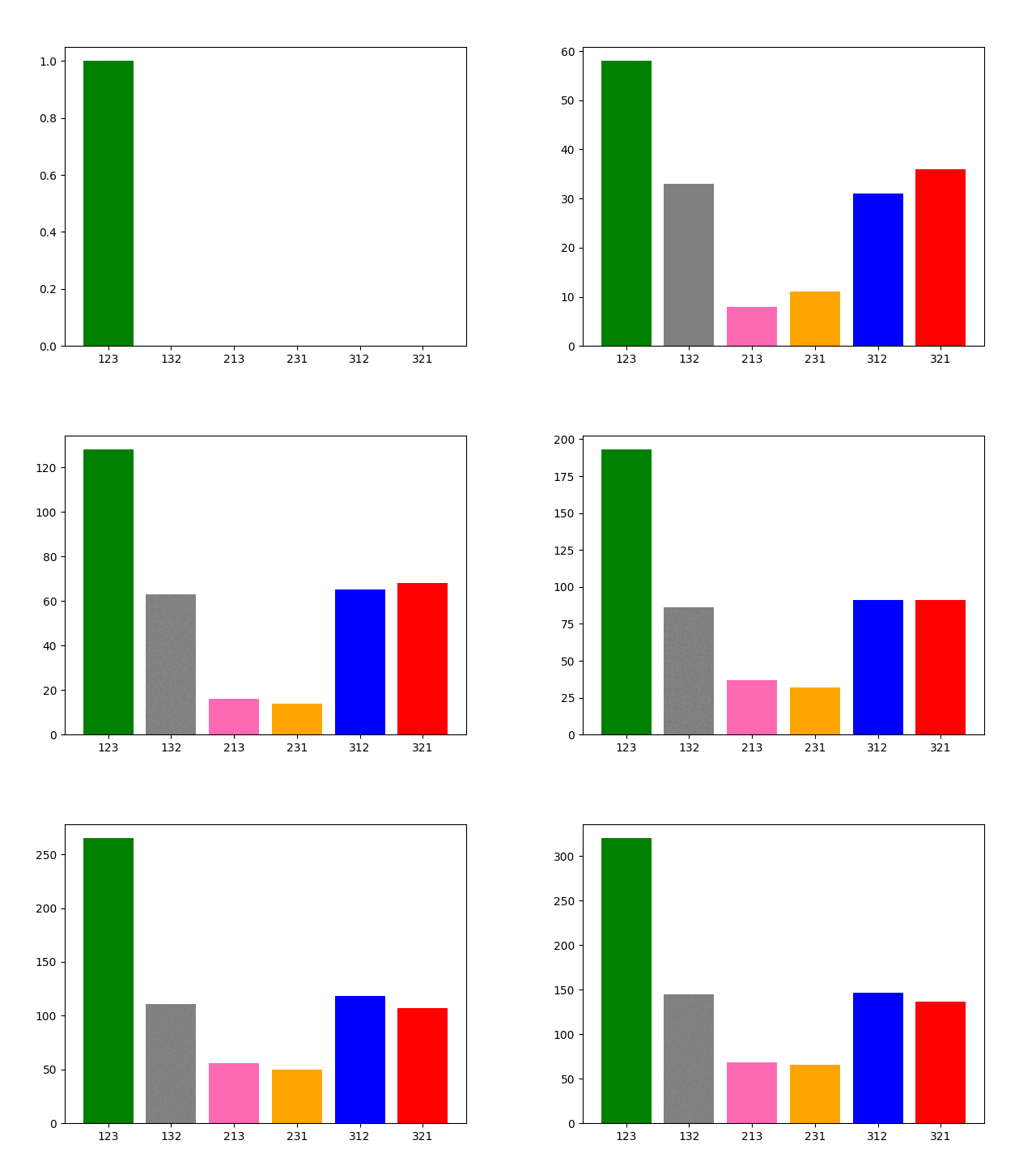
Time series data consists of real valued samples, indexed by a time parameter, such as daily stock returns or temperature values. I am particularly interested in probabilistic generative models for this data and their relation to entropy measures. Current work with Kate Moore focuses on clustering and detecting distributional changes using information-theoretic metrics and Markov based null models. These null models represent a given time series by a Markov chain defined on permutations, whose transition probabilities are inferred from the data. This model allows for both theoretical results for known distributions as well as an empirical test for divergence between the steady state of the Markov chain and the observed distribution.
Pickleball Analytics
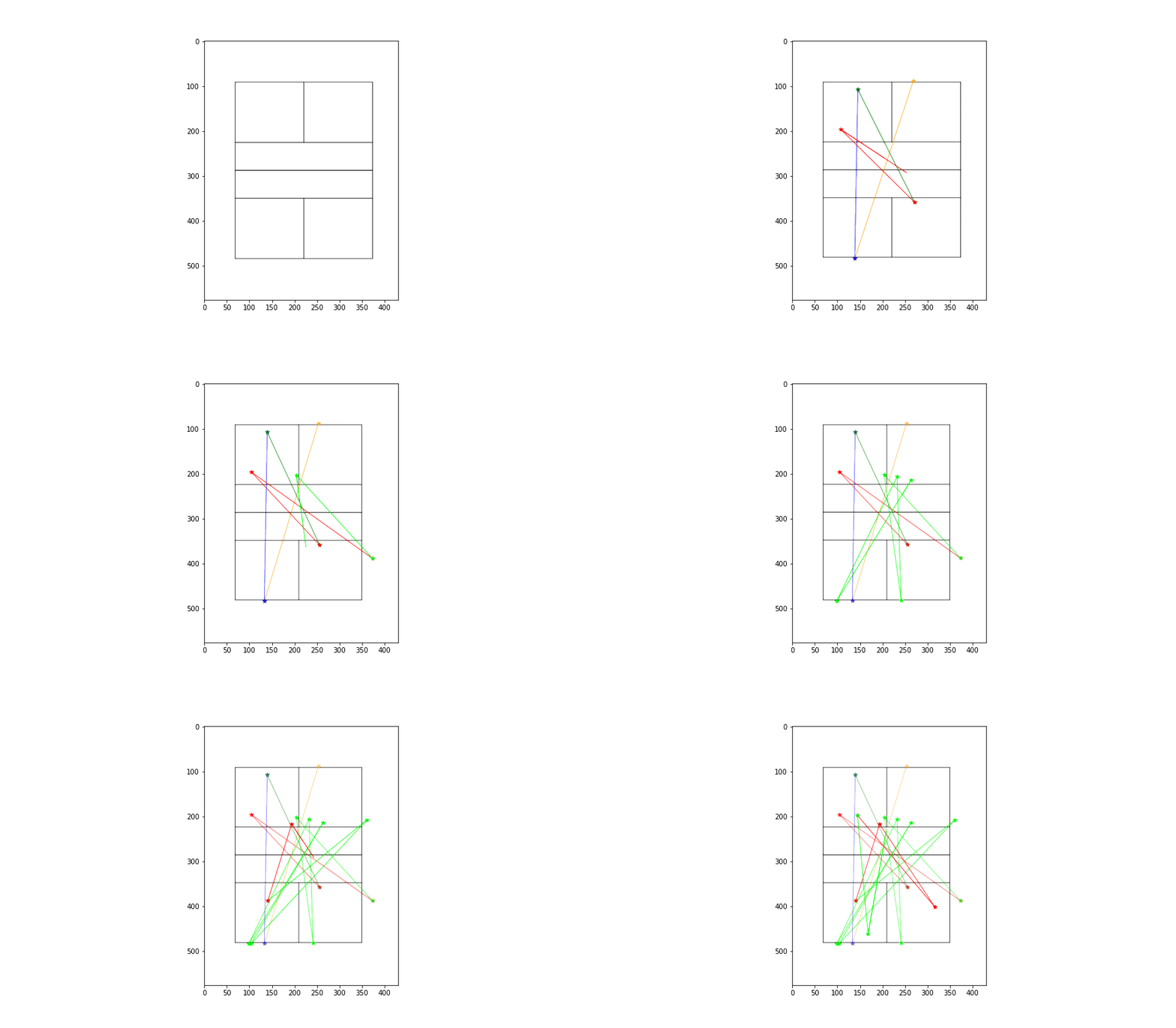
Motivated by a recent paper about tennis analytics I have been increasingly interested in analyzing pickleball match data and in studying the bracket design problem for fair recreational and tournament play formats. More information can be found on my Other Writing page. With S. Ethier we formulated a Markov chain representation of gameplay to evaluate win probabilities under different game models and there are several natural ways to extend that work. Additional current projects include:
- Analyzing shot distributions as a function of court position and shot type.
- Determining game and point winning probabilities as a function of serving rates and player ratings
- Analyzing the fairness properties of King of the Court models compared to round robin or elimination brackets
- Developing complete brackets for mixed partner mixed doubles round robin formats
Representations and Eigenvalues
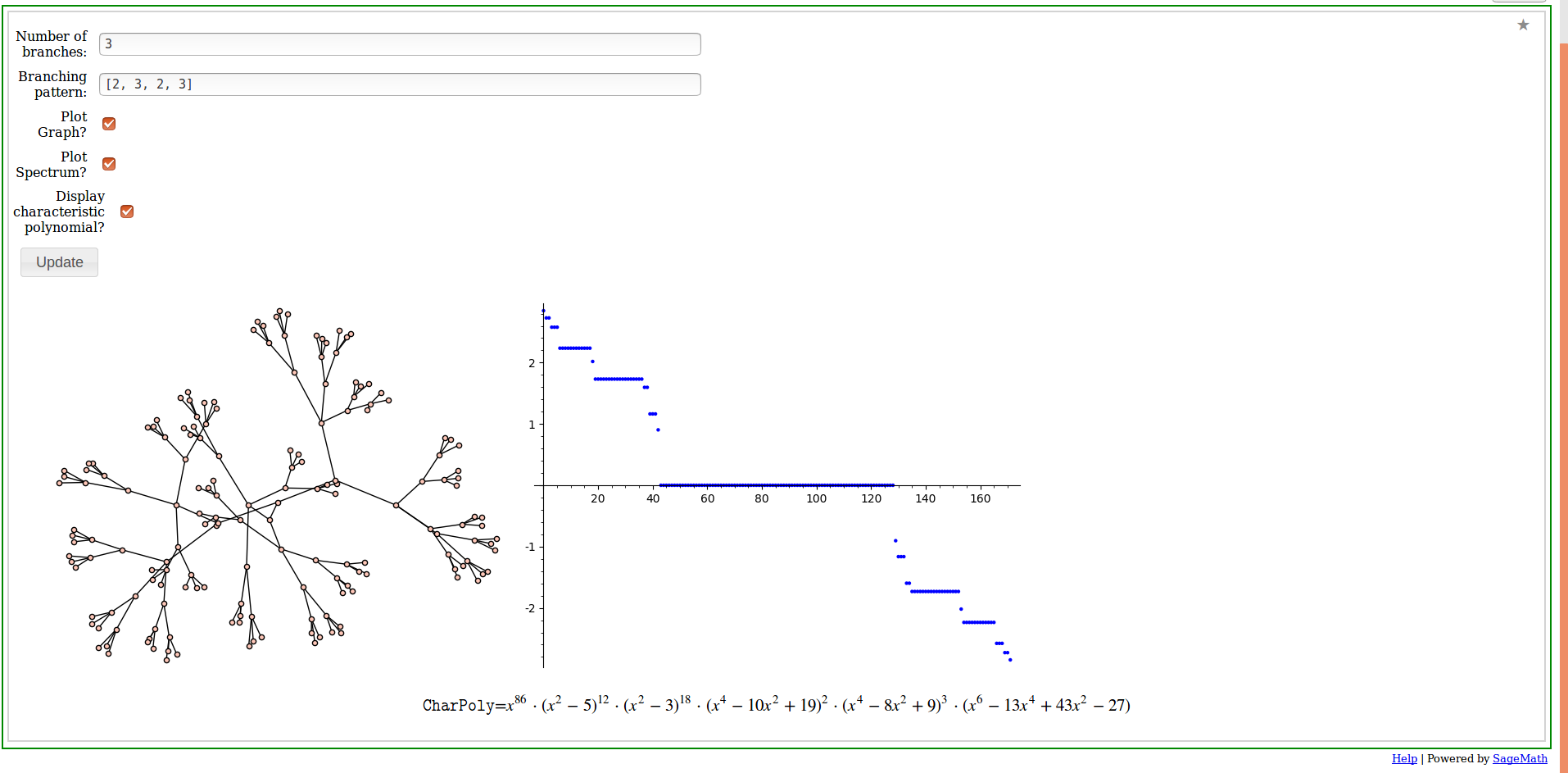
The connection between the Fourier transform on finite groups and eigenvalues of Cayley graphs leads to many natural questions, both in graph theory and representation theory. I am particularly interested in questions relating to the convergence of the spectral measures for sequences of these graphs. One way to formalize this quesion is to ask for a combinatorial characterization of increasing graph sequences that satisy for all \(\varepsilon > 0\) there exists a finite set \(\Lambda \subseteq \mathbb{R}\) and an integer \(N\) such that for all \(n > N\) we have \(\dfrac{|\{ \lambda \in \operatorname{spec}(G_n): \lambda \notin \Lambda\}|}{|\operatorname{spec}(G_n)|} < \varepsilon \). The future work sections of the papers linked above provide sketches of additional current research questions. Addtionally, various bases for the dihedral groups lead to families of interger spectra graphs, while others define a periodic spectral structure that appears to obey a well-defined limit law. Explaining these phenomena is an ongoing research project, see here and here for related software and figures.
Multiplex Networks
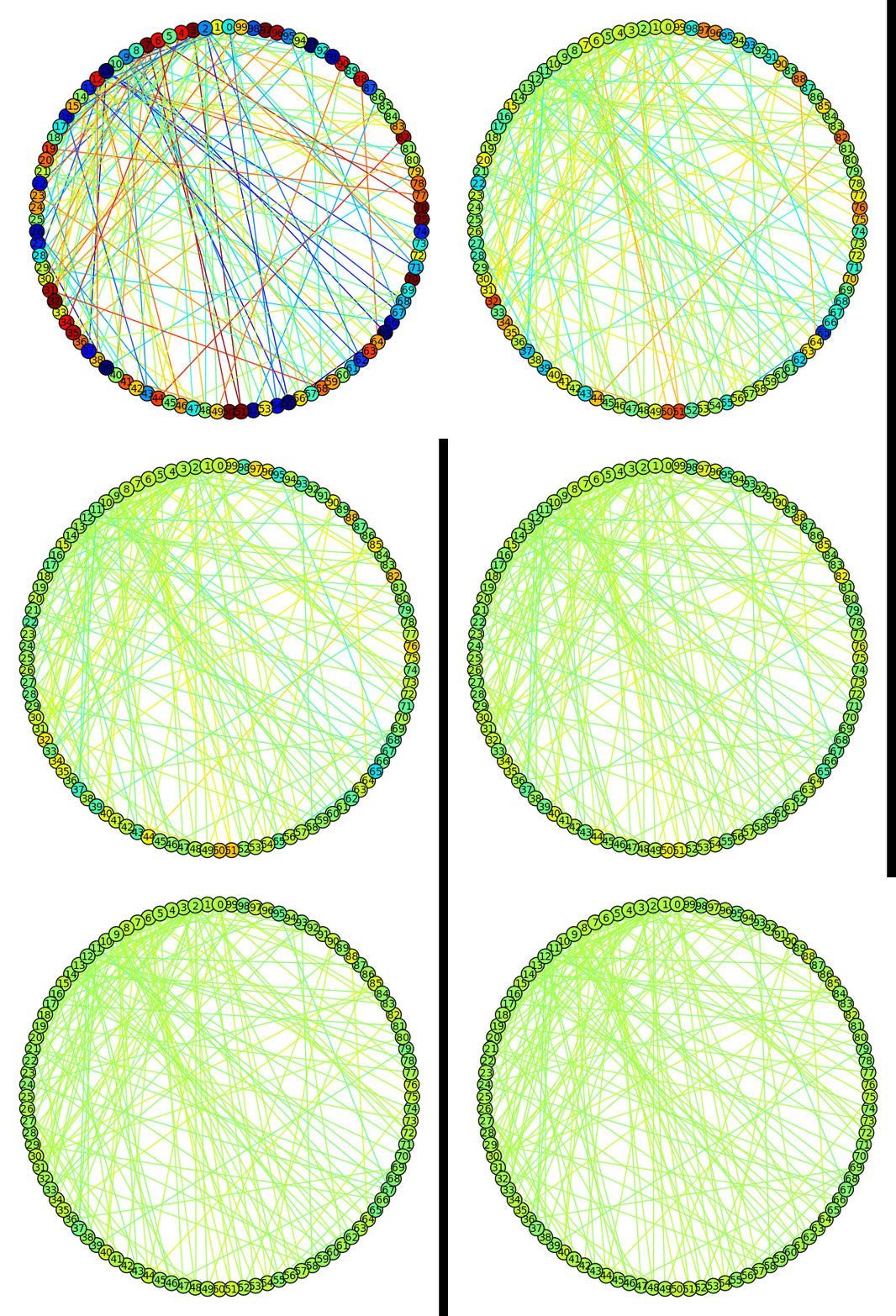
While standard network models consider a set of nodes an a binary relation between them, multiplex networks allow for many different types of connections between the nodes. For example, we might consider a social multiplex whose nodes are people and where different types of edges represent familial ties, coworkers, and friendship relations.
I am particularly interested in dynamical models on these networks, such as information flow through our social network example, and the properties of their associated operators. Current research includes developing clustering algorithms that respect multiplex structure and better understanding the effects of modeling choices in application domains, as well as machine learning approaches for inferring inter-layer edge weights.
Other Projects:
This section contains links to brief descriptions of various research projects, outside of my main areas, that have also captured my interest. Each .pdf contains some background material, thoughts on possible approaches, and a bibliography.
- Computing Stirling numbers for families of graphs and graph products
- Finding a module-theoretic decomposition of LHCCRR space and high-order Lucas Bases.
- Creating an efficient algorithm for finding minimal division chains
- Investigating the splitting behaviour of theta series lifted via spherical polynomials
- Applying SFC methods to develop efficient implementations for scientific computing